
I hit my breaking point on a Tuesday afternoon staring at a Google Calendar screen that looked like a solid block of blue Tetris bricks. I was scheduled for 37 hours of meetings that week. My specific problem wasn’t just the exhaustion; it was the realization that after a 45-minute “Q3 Alignment Sync” with twelve senior team members, I still did not know if we were launching the new checkout feature on Monday. The meeting ended with our lead developer saying, “Let me look into the API limits, and we’ll schedule a follow-up for Thursday.” That Thursday meeting spawned two more separate breakout sessions.
Over my five years working in Workplace & Career Intelligence, operating under the name William Henry to audit and restructure communication workflows for mid-sized tech companies, I have seen this exact scenario destroy productivity. I realized that the exhaustion we feel isn’t just about screen fatigue. It stems from a very specific structural flaw: we stopped using meetings to make decisions. Instead, we use them to defer decisions, creating an endless cycle where every gathering spawns two more.
Key Takeaways
- Meetings fail when they focus on status updates rather than enforcing a final verdict on a specific issue.
- The “Decision Cascade” occurs when a meeting ends without a documented choice, guaranteeing future follow-up meetings.
- Shifting to a “Decision-First” asynchronous model requires specific templates, not just telling people to use Slack more.
- A strict “Output Mandate” guarantees that no meeting occurs without a tangible, irreversible decision recorded at the end.
The Anatomy of the Decision Cascade

Most generic advice tells you to shorten meetings to 25 minutes or mandate an agenda. I tested those methods rigorously. They fail. An agenda with five bullet points just ensures you speed-run through five topics without resolving any of them.
The structural flaw is the lack of a forced mechanism for finality. At my previous agency, the culture operated on back-to-back synchronous video calls. If a client requested a design change, the account manager booked a 30-minute call with the design lead, the copywriter, and the project manager. During one specific project redesign, I tracked the lifecycle of a simple header color change. It took four meetings over eight days. Why? Because the first meeting was spent reviewing the client’s email. The second was spent looking at three color options. The third was a debate on brand guidelines. The fourth was the actual approval.
In contrast, I later joined a fully distributed software firm that operated on total asynchronous communication. They had almost zero internal meetings. Their structural fix was brutal but effective: you could not request someone’s time unless a written proposal had already been circulated and debated in a shared document for 48 hours.
When I managed a product launch there, I drafted a 600-word Notion document outlining our exact marketing schedule, embedded a 3-minute Loom video explaining my rationale, and tagged the three necessary approvers. They had two days to leave comments. If they didn’t object by Thursday at 5:00 PM, the document became the default decision. We executed a three-month campaign without a single live video call.
To show exactly how these two environments compare, I tracked the metrics across both companies for standard project approvals.
| Workflow Mechanism | Traditional Sync Culture | Async “Decision-First” Culture | Meeting Spawning Rate (Unique) | My Personal Verdict |
| Status Updates | Weekly 60-minute team video call. | Automated Friday Slack prompt. | High (Often creates breakout calls). | Async is vastly superior for routine updates. |
| Brainstorming | Open-floor live discussion. | Individual written pitches on a shared board. | Medium (Usually requires a refinement call). | Live brainstorming favors the loudest voice; async favors the best idea. |
| Project Approvals | Multi-stakeholder presentation call. | 48-hour silent review protocol via Notion. | Very High (Always requires “let me check” follow-ups). | Async forces rigorous preparation and faster sign-off. |
| Urgent Blockers | “Quick sync” ad-hoc calendar invite. | High-priority Jira tag with Slack alert. | Low. | Traditional sync works best here. True emergencies require live intervention. |
The Controversial Fix: Pre-Reads Are Worthless Without Enforcement
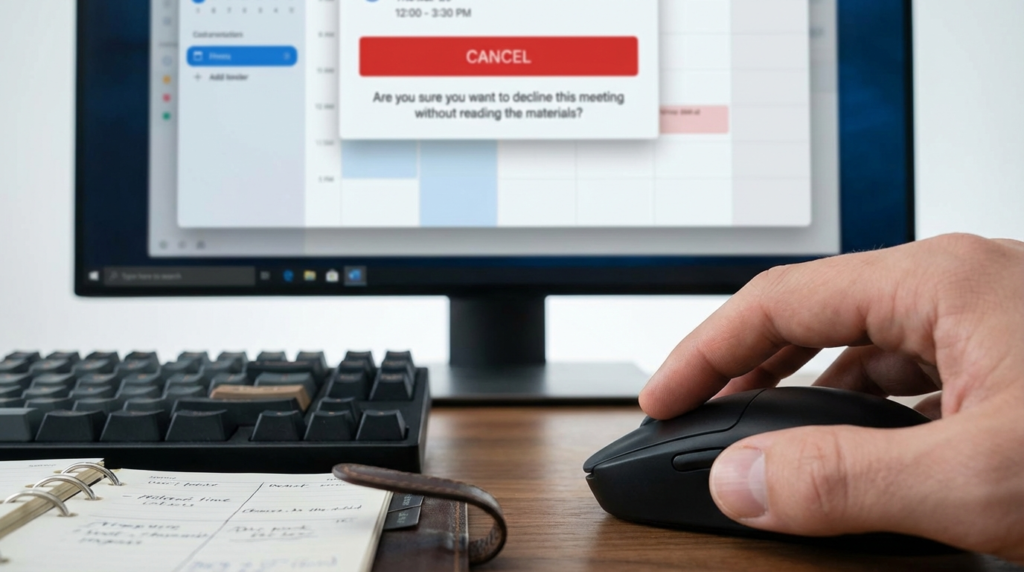
Here is a reality most productivity coaches won’t admit: sending a document ahead of time does nothing if you don’t penalize people for ignoring it.
The standard advice is to send a “pre-read” 24 hours before your meeting. Based on my testing across four different marketing teams, 80% of attendees will open that document exactly two minutes before the call starts. You then spend the first 15 minutes of your meeting reading the document together.
I implemented a strict “No Reading in the Room” rule during a six-month trial with a 50-person engineering team. If the decision-maker had not left comments on the document prior to the calendar invite starting, I cancelled the meeting immediately. The first week was chaotic. I cancelled seven meetings. People were furious. By week three, our total weekly meeting hours dropped from 420 collective hours to 115. People learned that if they wanted a say in the architecture decision, they had to read the specs and vote beforehand. The meeting itself was reserved only for debating the specific points of disagreement found in the comments.
Implementing the Output Mandate

To fix a broken meeting culture, you must change the fundamental requirement for booking time on the calendar. I call this the Output Mandate.
You do not need a meeting to share information. You only need a meeting to resolve friction.
Here are the exact mechanics I use to enforce this:
1. The “Verdict” Agenda Template
Instead of listing topics like “Discuss Q4 Budget,” your agenda must be phrased as a binary choice. My standard calendar invite format requires the organizer to fill out this specific prompt:
- The Decision: Are we allocating $50,000 to the paid search campaign or the influencer partnership?
- The Context: Link to the data sheet showing last quarter’s returns.
- The Consequence of Delay: If we do not decide by 2:00 PM today, we lose the vendor discount.
If the invite does not contain a binary choice and a consequence, I decline it automatically.
2. The 48-Hour Silent Protocol
For complex approvals involving more than three stakeholders, force the initial review offline. Create a shared document detailing the proposal. Assign a specific deadline for written feedback.
I use a standard template with a section at the bottom titled “Dissenting Opinions.” If a team member disagrees with the proposal, they must write their objection there and propose a specific alternative. “I don’t like this” is not an acceptable comment. “I disagree because the server load will double; we should use AWS instead” is acceptable.
Only the unresolved comments in the “Dissenting Opinions” section make it to a live meeting.
3. The “No Spectators” Rule
If an employee is attending a meeting just to “stay in the loop,” they are wasting company money and their own bandwidth.
During an audit of a logistics company, I found that their daily operations sync included 14 people, but only three actually spoke. I removed 11 people from the invite and set up an automated transcription tool to send a bulleted summary to the general Slack channel immediately after the call ended. The spectators got their information five times faster, and the decision-makers resolved issues without an audience slowing them down. If your voice is not required to finalize the verdict, you should not be on the call.
Frequently Asked Questions
What do I do if my manager insists on having daily sync meetings?
Request a trial period. Propose replacing two of the five daily syncs with a structured, automated written update for two weeks. Track the exact amount of time saved and present the data to show how that reclaimed time was spent on deep work or client deliverables.
How do you handle complex, emotional disputes asynchronously?
You don’t. The Output Mandate is for operational decisions, not interpersonal conflict or highly sensitive structural changes. If a topic involves performance reviews, major strategic pivots, or team friction, default to a synchronous, face-to-face (or live video) conversation immediately.
What is the best tool for moving from sync to async communication?
The tool matters less than the behavior, but I rely heavily on asynchronous screen recording tools like Loom combined with structured document hubs like Notion or Confluence. The combination of seeing someone’s screen while hearing their voice removes the ambiguity that often plagues pure text emails.
Won’t a “Decision-First” culture make people feel left out?
Initially, yes. People conflate “being invited to the meeting” with “being valued by the company.” You fix this by making the written decision-making process radically transparent. Everyone can see the document and read the rationale, even if they aren’t the final approver, which actually builds more trust than a closed-door video call.
Final Verdict
Your calendar is full because your company relies on gathering people together to mask a fear of definitive action. A meeting that results in another meeting is a failure of leadership, not a failure of scheduling.
Transitioning away from a synchronous-heavy culture requires forcing your team to do the hard work of reading, thinking, and proposing solutions before they ever look at a webcam. Implement the Output Mandate, enforce strict prerequisites for booking time, and ruthlessly cut spectators from your calendar invites. The friction you introduce at the scheduling phase will eliminate the exhaustion you feel at the end of the day. Treat your live meetings as an expensive, limited resource reserved solely for breaking ties and finalizing verdicts.