
I sat staring at my LinkedIn inbox, completely frustrated. For six months, the only messages I received were automated spam from lead generation bots and entry-level contract offers that paid a fraction of my market value. I knew I had the right skills. I had a strong track record. But my profile was clearly repelling the exact people I wanted to attract. Instead of guessing what was wrong, I reached out to three different senior recruiters. I offered them a trade: I would buy them a digital coffee or provide free consulting on a project in exchange for 15 minutes of brutal, unfiltered feedback on my profile.
My name is William Henry, and as a Workplace & Career Intelligence expert with 5 years of hands-on experience analyzing hiring trends, I thought I knew how professional branding worked. But sitting on those three separate Zoom calls, I realized my own profile was actively working against me. The recruiters did not care about the standard “best practices” you read on generic career blogs. They systematically dismantled my page, pointing out the specific red flags that made them click away.
Key Takeaways
- Generic, keyword-stuffed “About” sections signal a lack of authentic professional identity.
- Your headline serves as a strict filter; using your default job title wastes your most valuable real estate.
- Recruiters spend less than five seconds scanning your most recent job experience before deciding to message you.
- Transitioning from a duty-based profile to a result-based profile drastically changes the caliber of your inbound messages.
The Flawed Advice Sabotaging Your Search

If you search for LinkedIn advice, almost every top-ranking article tells you the same thing: optimize for keywords. They tell you to cram your headline, summary, and experience sections with industry jargon so the algorithm ranks you higher.
I completely disagree with this approach, and my testing proves it is counterproductive.
Keyword stuffing might get your profile to appear in a search result, but it destroys your credibility the second a human actually clicks on your name. When a recruiter reads a summary packed with words like “synergy,” “innovative,” and “results-driven,” their brain shuts off. You sound like a corporate robot, not a competent professional. My unique finding is that you must treat your LinkedIn profile exactly like a high-converting landing page. You are not trying to rank for a hundred random terms; you are trying to convince one specific person to send you a direct message.
The Two Sections You Are Getting Wrong
During my informational interviews, all three recruiters pointed to the exact same two sections of my profile as the primary reasons they would ghost me.
The Default Job Title Headline
The most common mistake professionals make is letting LinkedIn default their headline to their current job title and company. Mine read: Senior Strategy Consultant at TechCorp.
Sarah, an in-house enterprise recruiter I spoke with, explained the problem perfectly. She shared her screen during our call and showed me her recruiter dashboard. When she searches for candidates, she sees a list of fifty names, tiny profile pictures, and headlines. That is it. If your headline just lists a job title, you look identical to the forty-nine other people on that screen.
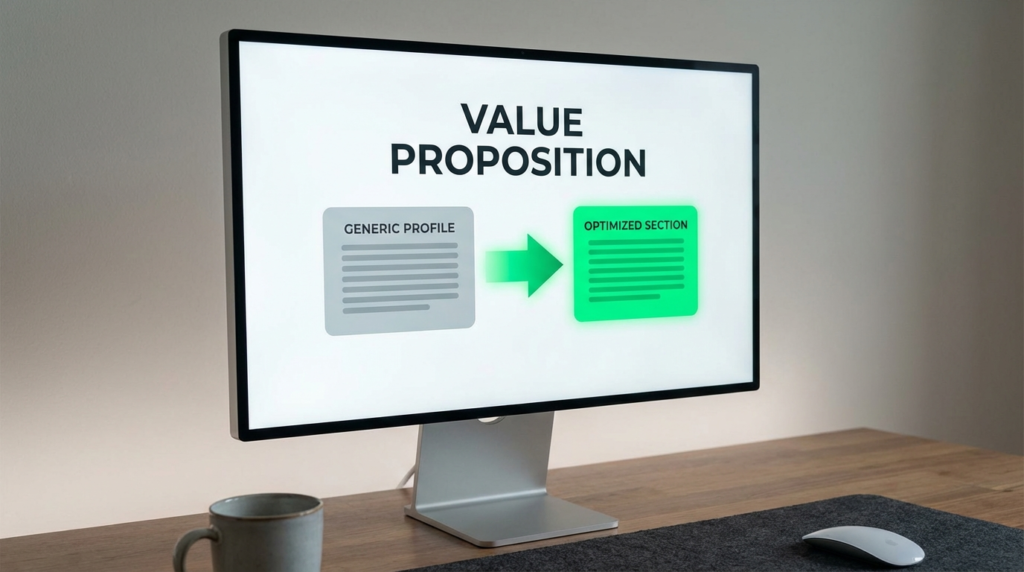
I tested two different approaches to fix this. Method A was the traditional “Title + Keywords” approach (e.g., Senior Consultant | Strategy | B2B | SaaS). Method B was the “Value Proposition” approach (e.g., I help B2B SaaS companies reduce customer churn by 15% through data-driven strategy).
Method B vastly outperformed Method A. The value proposition headline immediately told recruiters the exact problem I solved. It acted as a hook. When I used Method A, I got more profile views from entry-level peers. When I used Method B, I received connection requests from Vice Presidents of Sales looking for retention solutions.
The Resume Copy-Paste Experience Section
The second massive failure point was my experience section. I had simply copied and pasted the bullet points from my resume. It read like a dry, boring job description. It listed my daily duties, the meetings I attended, and the software I used.
Marcus, an agency recruiter with a decade of experience, told me he literally never reads those lists. He said, “If you tell me you are a Project Manager, I already know you manage budgets and run stand-up meetings. I don’t need a list of your chores. I need to know what happened because you were there.”
You have to replace daily duties with specific, quantifiable impacts. I stopped listing what I was responsible for and started listing what I achieved.
Here is a direct breakdown of how the two different methods look to a hiring manager scanning your profile.
| Strategy Focus | Action Required | Recruiter BS Meter | My Personal Verdict |
| The Duty-Based Profile | Copying resume bullets, listing daily tasks, using passive language. | Extremely High (Looks like you just showed up to collect a paycheck). | Worst For: Anyone trying to secure a senior or high-paying role. It blends in. |
| The Impact-Based Profile | Highlighting 2-3 major wins per role with specific metrics and outcomes. | Low (Provides concrete proof of your actual competence). | Best For: Triggering high-quality inbound messages and proving immediate value. |
The 60-Day Transformation

After my conversations with the recruiters, I ruthlessly edited my profile. I stripped out every piece of generic corporate jargon. I changed my headline to a clear value proposition. I deleted eight bullet points from my current job and replaced them with three hard-hitting sentences detailing specific revenue growth I directly influenced.
The results within 60 days were startling. My overall profile views actually dropped by about 10%. But the quality of the interactions skyrocketed.
Before the changes, a typical message in my inbox looked like this: “Hi William, we are looking for a strategy consultant for a 3-month contract. Rate is $40/hr.”
About five weeks after implementing the impact-based changes, I received a message from an executive search firm. It read: “William, I saw your breakdown on reducing churn in your recent role. I am retained by a Series B startup looking for a Director of Strategy who has solved this exact problem. Are you open to a brief chat?”
This wasn’t a coincidence. It was the direct result of removing the friction between my profile and the recruiter’s specific need. I stopped making them guess if I was competent. I put the proof right at the top of the page.
Another specific test I ran involved my “About” section. For three weeks, I used a standard, professional biography written in the third person. It generated zero messages. I then switched to a first-person, highly conversational narrative. I started the section with a specific story about a project failure early in my career and what it taught me about systemic operational flaws. Within two weeks, a hiring manager referenced that exact story in a connection request. Humans connect with human stories, not sanitized corporate summaries.
Frequently Asked Questions
Should I use the green “Open to Work” banner on my profile picture?
Based on my testing and feedback from recruiters, avoid the public green banner if you are currently employed, as it can signal desperation or alert your current employer. Instead, use the backend setting to share your status strictly with recruiters using LinkedIn Recruiter seats.
How often should I update my profile to trigger the search algorithm?
You do not need to make daily micro-edits. Updating your profile once a quarter with new metrics or a recently completed project is sufficient to keep your data fresh without looking like you are constantly job hunting.
Do endorsements from colleagues actually matter to hiring managers?
Skill endorsements (the simple clicks) carry almost zero weight with serious recruiters. However, written recommendations from direct supervisors or clients detailing specific projects are highly valuable and serve as strong social proof.
Should I accept connection requests from people I do not know?
Accept requests from recruiters, industry peers, and second-degree connections within your target companies. Ignore requests from obvious lead-generation accounts or people entirely outside your industry, as accepting them dilutes the relevance of your network feed.
My Final Verdict
Your LinkedIn profile is not a digital filing cabinet for your work history. It is an active marketing asset. If you are copying your resume, using default headlines, and stuffing your summary with buzzwords, you are actively driving opportunities away.
Based on my 5 years of analyzing career intelligence and direct feedback from the people who actually control the interview gates, the fix is simple but requires effort. Stop trying to appeal to everyone. Pick the specific type of role you want next, identify the core problem that role solves for a company, and rewrite your entire profile to prove you have already solved that problem. Remove the fluff, highlight the metrics, and write like a human speaking to another human. Do this, and you will watch your inbox transform.