

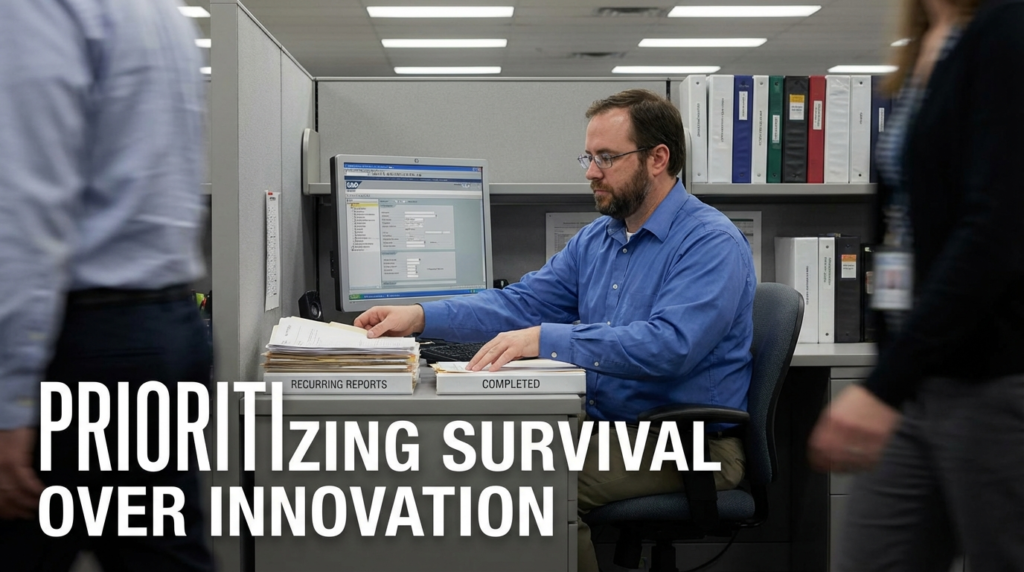
I stared at my screen on a Tuesday afternoon and realized I had not pitched a genuinely new idea in 14 months. I knew the exact approval chain for my department. I knew the specific objections my manager would raise before she even opened her mouth. I optimized my daily output entirely for safety. I traded innovation for friction-free survival.
I am William Henry, and with five years of hands-on experience in Workplace & Career Intelligence, I analyze exactly how corporate environments rewire human behavior. But before I built this expertise, I spent six uninterrupted years in the exact same strategy role. I thought I was building deep, irreplaceable value. Instead, I systematically dismantled my ability to handle risk. When I finally left that position, I spent four brutal months recalibrating to a new environment that demanded immediate, ambiguous problem-solving. My professional ambition had shrunk to fit the exact dimensions of my cubicle.
Key Takeaways
- Long tenure replaces active problem-solving skills with passive institutional memory.
- Comfort zones actively shrink your baseline tolerance for undefined outcomes.
- Standard career advice ignores the cognitive atrophy caused by staying in one place.
- You must artificially inject discomfort into your routine to maintain professional agility.
Why Standard Career Advice Fails Completely
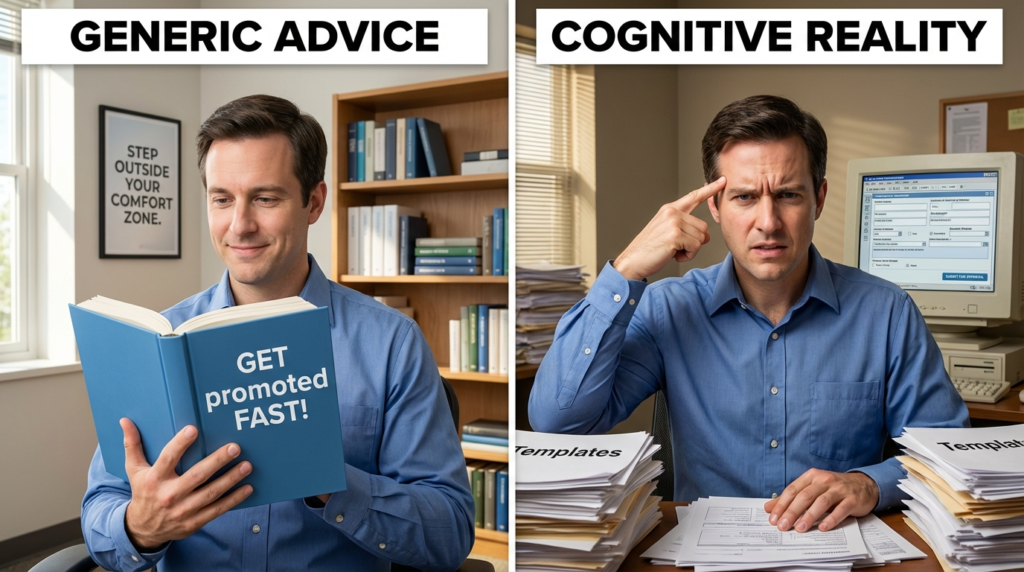
Search for advice on career stagnation, and you find the same recycled platitudes. Competitors tell you to “step outside your comfort zone,” “take a lateral move,” or “find a mentor.” I completely reject this generic advice. You cannot fix a structural cognitive habit with a superficial action.
The actual problem is neurological. When you stay in one role for five years, your brain optimizes for efficiency. You stop analyzing problems from first principles. You start relying on shortcuts. A lateral move inside the same company keeps you within the same cultural safety net. You need to understand how tenure actively degrades your decision-making before you can fix it.
Three Ways Tenure Rewires Your Professional Brain
During my six years in my previous role, I documented specific cognitive shifts. These are not personality flaws. They are predictable adaptations to a static environment.
1. Over-Reliance on Institutional Knowledge
You stop learning how to solve problems and start learning who to ask. In my fourth year, our division faced a massive software migration. Instead of reading the technical documentation to understand the risks, I just walked down the hall to ask our lead developer what to do. I outsourced my critical thinking. When you rely solely on institutional knowledge, your independent problem-solving muscles atrophy.
2. Paralyzing Discomfort with Undefined Outcomes
In a familiar role, you know exactly what success looks like. You know how your boss measures a “good job.” When I left my long-term role, my new employer gave me an open-ended mandate: “Fix the onboarding pipeline.” There were no templates. There was no established precedent. I felt genuine, physical panic. I realized I had lost the ability to operate without a clear rubric.
3. The Subtle Shrinkage of Ambition
You stop pitching ideas that might fail. During my fifth year, I noticed a massive inefficiency in our client reporting structure. I had the skills to build a better system. I chose not to. I knew the CFO hated changing reporting formats, and I did not want to endure the friction of persuading him. I catered to his bias instead of arguing for a better outcome. I chose comfort over impact.
The Four-Month Recalibration
Leaving that comfortable role forced a harsh reset. My new environment demanded blind problem-solving. I could no longer rely on my accumulated internal favors. I had to evaluate risk differently.
I tested two different approaches to managing projects during this recalibration phase. The contrast between my old habits and my necessary new habits was stark.
| Feature / Behavior | The Tenured Comfort Approach | The Calibrated Risk Approach | Cognitive Blindspot Trigger (Unique Variable) | My Personal Verdict |
| Information Gathering | Asking the same internal experts | Reading primary source documentation | High: You inherit other people’s biases | Fails in new environments |
| Pitching New Ideas | Checking the manager’s mood first | Presenting data-backed prototypes | High: You optimize for approval, not results | Ineffective for real growth |
| Handling Failure | Blaming established company processes | Owning the outcome and iterating | Extreme: Process shields you from accountability | Dangerous to long-term career |
| Project Initiation | Waiting for clear, step-by-step instructions | Defining the scope and acting independently | Low: Forces active brain engagement | Best For building authority |
My Controversial Take: Institutional Knowledge is a Liability

Here is a truth you will not find on popular job boards. Most people believe knowing a company inside and out makes you highly valuable. I argue the exact opposite. After year three, institutional knowledge becomes a massive liability.
It makes you lazy. You stop looking at industry trends because you know how “we do things here.” You stop updating your skills because your current employer does not require them. You become highly optimized for a single, specific environment. If that environment changes—through a merger, a layoff, or a new CEO—your specialized knowledge drops to zero value overnight. You are left with degraded risk tolerance and outdated skills.
How to Force Risk Back Into Your Routine
You do not have to quit your job today to fix this. However, you must actively disrupt your daily patterns. Based on my recalibration period, these are the exact steps I use to maintain my risk tolerance.
- Implement the “Zero-Precedent” Rule: Once a quarter, volunteer for a project where you have absolutely no prior experience. Do not ask a colleague how to do it. Force yourself to build the solution from scratch.
- Audit Your “No” Reflex: Track every time you decide against pitching an idea. Write down the reason. If the reason is “it might cause friction” or “it will take too much effort to get approved,” you are suffering from tenure complacency.
- Build External Feedback Loops: Show your work to professionals outside your company. Join an industry group. If your only feedback comes from people who share your institutional biases, you will never know if your skills are actually competitive.
- Create Artificial Deadlines: Parkinson’s Law states that work expands to fill the time allotted. In a tenured role, you know exactly how long you can delay a task. Cut your internal deadlines in half. Force yourself to make faster, slightly riskier decisions under self-imposed pressure.
Frequently Asked Questions
Does staying in one role look bad on a resume?
Staying in one role only looks bad if your responsibilities remain identical. If you can show clear, progressive impact and distinct project phases, long tenure signals loyalty rather than stagnation.
How do I know if my risk tolerance has actually dropped?
Look at your last three major decisions at work. If all three relied heavily on existing company templates or required zero new skill acquisition, your tolerance for risk has significantly degraded.
Can I regain my problem-solving skills without changing companies?
Yes. You must actively demand cross-departmental projects or pitch initiatives that fall entirely outside your current job description to force new cognitive patterns.
Is it normal to feel panic when taking on undefined tasks after a long tenure?
Absolutely. It is a neurological response to losing your established safety net. The panic usually subsides after three to four months of consistent, forced exposure to new problem sets.
My Recommendation
You must treat your risk tolerance like a physical muscle. Five years in the same role without deliberate disruption will atrophy that muscle. My final verdict is simple: audit your daily friction. If your job feels completely frictionless, you are in danger. Do not wait for a layoff or a forced restructuring to test your adaptability. Start injecting calculated risks into your workflow this week. Pitch the bold idea. Stop asking for permission for minor changes. Reclaim your ability to handle undefined outcomes before your current comfort zone permanently caps your career potential.