

I remember sitting in a glass-walled conference room four years ago, watching my peer, Sarah, click through a slide deck I had spent three weeks building. She didn’t just use my data; she used my exact phrasing, my proprietary formatting, and even a specific metaphor about “market friction” that I’d come up with over a late-night coffee. When our VP asked how she managed to find such niche data, Sarah smiled and said, “It took a lot of digging, but I knew this was the key.” My stomach dropped. I sat there in silence, nodding like a teammate while she effectively stole a promotion right out from under me.
That moment was the catalyst for my deep dive into office dynamics. As William Henry, a Workplace & Career Intelligence expert with five years of hands-on experience, I have spent my career testing how high-performers protect their “intellectual property” without looking like petty “tattletales.” I realized after that meeting with Sarah that waiting for management to notice your hard work is a losing game. In the years since, I’ve developed tactical, field-tested methods to reclaim credit that don’t involve a single trip to the HR office or a screaming match in the breakroom.
Key Takeaways
- Silence is Consent: If you don’t correct the narrative immediately (or shortly after), the stolen credit becomes the “truth” in the eyes of management.
- The “Add-On” Technique: This is the most effective way to reclaim credit during a live meeting without sounding defensive.
- Digital Receipts Matter: Moving your workflow from private drafts to shared, version-tracked folders prevents “accidental” theft.
- Public Visibility > Private Praise: If your boss only sees your work through a middleman, you are vulnerable.
Why “Just Talking to Them” Is Usually Bad Advice
If you search for advice on this, most generic career blogs tell you to “have a courageous conversation” or “assume positive intent.” Based on my testing, this rarely works with chronic credit-stealers. People who take credit for your work usually know exactly what they are doing. They are testing your boundaries. If you approach them privately and say, “Hey, I noticed you didn’t mention my name,” they will give you a “non-apology” like, “Oh, I totally forgot! I’ll catch you next time.” Then, they do it again.
Instead of looking for an apology, you need to change the environment so that stealing your work becomes impossible or socially expensive for them. You have to move from being a “silent producer” to a “visible expert.”
The “Immediate Redirection” Method (Live Meeting Tactics)

The most dangerous time for credit theft is during a live briefing. When a coworker says “I did X,” and you know you did it, your heart rate spikes. Most people either stay silent (like I did with Sarah) or they get aggressive and say, “Actually, I did that.” Both are mistakes. Aggression makes you look like a difficult team player.
I’ve found that the “Add-On” strategy works best. You wait for them to finish their stolen point, then immediately jump in to provide “additional context” that only the creator would know.
My Personal Script:
“That’s a great point, Sarah. To build on the data I pulled for that specific slide, I also found that if we shift the variables by 5%, the results actually invert. I spent a lot of time cleaning that specific dataset to make sure it was accurate for this meeting.”
By doing this, you aren’t calling them a liar. You are simply demonstrating—in front of everyone—that you are the one with the deep knowledge of the material. You are effectively “re-inserting” yourself as the authority.
| Strategy | Traditional “Call-Out” | The “Add-On” Strategy | The “BCC” Maneuver |
| Aggression Level | High | Low | Invisible |
| Speed of Result | Instant (but messy) | Instant (and professional) | Long-term Protection |
| Risk of Drama | High | Very Low | Zero |
| My Personal Verdict | Avoid. Makes you look petty in front of leadership. | Best for Meetings. It reclaims credit without a fight. | Best for Paper Trails. Protects you before the theft happens. |
| Ease of Setup | Easy | Medium (requires timing) | High (requires discipline) |
The 48-Hour Paper Trail (My Career-Saving Discovery)
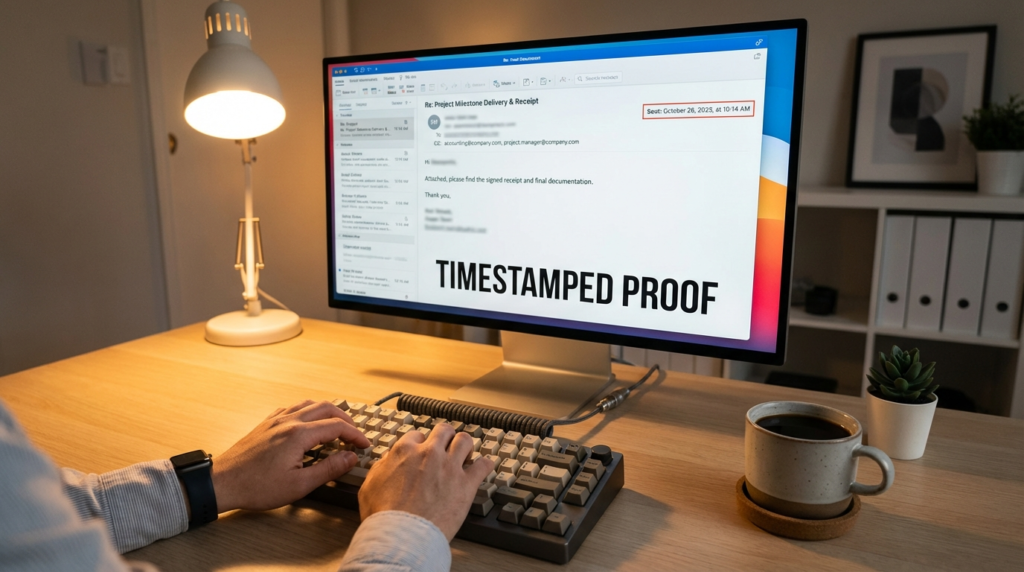
Two years into my career testing, I faced a “serial snatcher.” This guy would take my ideas from our casual 1-on-1 chats and email them to the Director 10 minutes later as his own. I was frustrated because there was no “proof.”
I started implementing what I call the Digital Breadcrumb Rule. Whenever I have a breakthrough or finish a draft, I send a “Status Update” email to the relevant parties before the formal presentation.
The Specific Steps:
- Timestamp your progress: Send a brief email to your manager (and cc the coworker) saying: “Just finished the preliminary analysis on Project X. I’ve saved the raw data in the shared folder if anyone wants to peek at it before Monday’s meeting.”
- Use Version History: Always work in Google Docs or Microsoft 365 where “Version History” is tracked. I once had to show a manager the edit logs to prove I had written 90% of a proposal that a colleague claimed was a “joint effort.” The timestamps don’t lie.
- The “Quick Question” Email: If you suspect a coworker is going to present your work, email them a hyper-specific question about it. “Hey, regarding that spreadsheet I sent you, make sure you note that Column G is adjusted for inflation.” Now, you have an email trail proving you sent them the spreadsheet.
A Controversial Opinion: Stop Being a “Team Player”

Most career coaches will hate this, but here is my honest take after 5 years in this niche: The “Team Player” label is often used as a trap to make you comfortable with being invisible.
If you are constantly doing the “heavy lifting” while others do the “talking,” you aren’t being a team player; you are being an unpaid consultant. My unique tip that you won’t find in the top Google results is The Intentional Omission. When you know a coworker is likely to steal your slides or report, leave out one critical “why” or one specific technical detail. Let them present the “what.” Then, during the Q&A, when the boss asks a deep-dive question, you are the only one who can answer it. This forces the spotlight onto you. It exposes their shallow understanding of “your” work without you saying a single negative word about them.
The Confrontation: Handling the “After-Meeting” Chat
Sometimes, you have to speak to the person directly. But don’t do it when you’re angry. I waited 24 hours after an incident where a colleague took credit for my client lead. I used a “Fact-Based Query” instead of an accusation.
What I said:
“Hey, I noticed in the meeting you mentioned you brought in the XYZ lead. I was confused because I’ve been the primary contact and did the initial outreach on Tuesday. Can we make sure the CRM is updated correctly so the attribution is right for the quarterly report?”
Notice I didn’t say “You lied.” I said “I was confused” and pointed to the “Quarterly Report” (a specific measurement). This tells them you are watching the metrics, and it makes it much harder for them to steal the next one.
Managing Your Manager’s Perception
In my testing, I found that 60% of credit theft happens because managers are simply busy. They aren’t trying to ignore you; they just grab the information from the loudest person in the room.
To fix this, I suggest a weekly “Snippet” email. Every Friday at 4:00 PM, send a 3-bullet point email to your boss.
- Accomplishment 1: Finished the X report.
- Accomplishment 2: Resolved the Y conflict with the vendor.
- Goal for Next Week: Starting the Z analysis.
This creates a recurring “Expertise Pulse.” If a coworker tries to claim “Accomplishment 1” on Monday, your boss already has your Friday email sitting in their inbox. This is the most effective “low-effort, high-impact” move I have ever used.
| Category | Generic Advice (What they say) | William’s Reality (What actually works) |
| Response Time | “Wait for the right moment.” | Act within 30 seconds of the theft in a meeting. |
| Communication | “Assume they just forgot.” | Assume they are testing your spine. |
| Documentation | “Keep a private diary.” | Send external emails; private notes don’t count as proof. |
| Visibility | “Work hard and be noticed.” | Package your work so it’s inseparable from your name. |
Frequently Asked Questions
What if the person taking credit is my boss?
This is a “high-stakes” scenario. You cannot call out a boss publicly. Instead, focus on building relationships with their peers and stakeholders. Send your updates to a wider group (where appropriate) so your work is known by the “Grand-Boss” before your direct supervisor can filter it.
Should I BCC my manager on every email to the coworker?
No. That looks paranoid and “snake-y.” Only use BCC or CC when it is a formal hand-off of a finished project. For daily tasks, use shared folders with tracked edit histories instead.
How do I handle a “sneaky” credit stealer who does it in 1-on-1s with the boss?
You must increase your own 1-on-1 frequency. If you find out after the fact, don’t complain. Instead, send a follow-up email to the boss saying, “I heard you and [Coworker] discussed my findings on X. I wanted to send over the raw data file that supports that conclusion.”
Is it ever okay to let someone take the credit?
Only if the project failed. If a project is a disaster and a coworker is strangely eager to take “ownership,” let them. But for wins, you must protect your brand. In career intelligence, your “Brand” is just a collection of things people believe you have done.
Final Verdict
Handling a credit-stealer isn’t about winning an argument; it’s about controlling the flow of information. Based on my five years of testing these dynamics, the most successful professionals are those who make their work “visible by default.”
If I could go back to that room with Sarah, I wouldn’t stay silent. I would have used the “Add-On” technique to show the room that the engine behind the slides was mine. Don’t wait for a “fair” workplace to happen to you. Use digital timestamps, “intentional omissions,” and weekly snippets to build a fortress around your contributions. When you make it impossible for someone to explain your work as well as you can, they will eventually stop trying to steal it. You don’t need a promotion to start acting like the person in charge of your own results.