
Most independent news creators lose 40% to 50% of their audience before the 30-second mark. You look at your YouTube Studio retention graph, and the line drops like a stone. You tried the loud, fast-paced hooks that marketing channels recommend. It feels cheap, and your audience still clicks away. The problem is not your topic. The problem is you are using a vlog hook for a journalism format.
Real news organizations do not yell at the viewer. They use a specific broadcast cold open. This architecture builds immediate tension without sacrificing credibility. I build these structures daily for one-person newsrooms. I see exactly what keeps viewers watching and what makes them leave. Today, we break down the three exact broadcast cold opens, the word counts you need, and how to write them.
Why Traditional YouTube Hooks Fail for News Content
Standard YouTube advice tells you to tease the payoff immediately. Channels like Think Media or VidIQ push high-energy hooks. That works for tech reviews or challenge videos. It destroys authority in news content. When someone clicks a video about a geopolitical conflict or a local housing crisis, they want clarity. They do not want a game show host.
If you start a video about inflation with “You won’t believe how much money you are losing,” the viewer feels manipulated. Trust evaporates. The broadcast cold open relies on a completely different psychological trigger. It relies on authority and immediate grounding. We drop the viewer directly into the story. We give them context, stakes, and a reason to care in under 15 seconds. You establish yourself as the guide, not a hype man.
| Content Marketing Hook | Broadcast Cold Open |
| Hides the main fact to force viewers to wait | Gives the main fact immediately to establish trust |
| Uses high energy and fast talking | Uses measured pacing and deliberate pauses |
| Focuses on the creator’s reaction | Focuses entirely on the subject matter |
| Relies on sound effects and fast cuts | Relies on natural sound and steady visuals |
The Three Types of Broadcast Cold Opens

You have three specific frameworks to choose from. Do not mix them. Pick one based on the strongest asset of your story.
The Scene-Setting Open
Use this when you have strong visual evidence or a compelling location. You pull the viewer into a specific moment in time. The goal is to make them feel like they just walked into a room where something important is happening.
Do not say, “Today we are looking at the protests in France.” That is passive. Instead, anchor the script to the visual.
Example Script: “Tear gas is currently clearing the streets of Paris. Three thousand sanitation workers just walked off the job. And the mayor has exactly 48 hours to find a solution.”
Notice the structure. We give a current action, a specific number, and a ticking clock. It takes exactly eight seconds to say. It forces the viewer to stay to see the resolution.
The Declaration Open
Use this when your story uncovers a surprising fact or a broken system. You make a bold, undeniable statement right at the start. It must be 100% factual. Do not exaggerate.
Example Script: “The city of San Francisco spent 1.7 billion dollars on homelessness last year. The number of people on the street actually went up.”
The tension lives in the contradiction. The viewer instantly wants to know why the system failed. You do not need to add “and I am going to tell you why.” The contradiction itself does the heavy lifting.
The Focused Question Open
This is the most misused hook on YouTube. Amateurs ask broad, philosophical questions. “Have you ever wondered how the economy works?” Viewers immediately tune out. A broadcast question must be highly specific and tied to a known entity.
Example Script: “How did a 22-year-old college dropout convince Sequoia Capital to wire him 40 million dollars without a working product?”
This targets a specific person, a specific venture capital firm, and an exact dollar amount. The specificity makes the question impossible to ignore.
Writing the Cold Open Before the Script
Content creators usually write their video chronologically. They write the intro, the body, and the outro. This is a mistake. In a newsroom, we write the cold open first. It acts as the thesis statement for the entire video.
If you cannot write a compelling cold open in under 50 words, your story lacks focus. You do not know what the video is actually about yet. Writing the open first forces you to identify the core tension.
Once you lock in the 50-word open, the rest of the script builds backward from that promise. It prevents you from rambling in the middle of the video. Every subsequent paragraph must serve the premise you established in the first ten seconds.
Sentence Construction for Urgency
You create urgency through syntax, not volume. You do not need to speak faster or use dramatic music. You need tighter sentences. News writing strips away adjectives and adverbs. We rely on active verbs and concrete nouns.
Drop the passive voice immediately. Instead of saying “A decision was made by the board,” say “The board decided.” This saves time and sounds more authoritative.
Keep your sentences under 20 words. If you have a compound sentence with an “and” or a “but,” break it into two separate sentences. Short sentences create a driving rhythm. This rhythm keeps the viewer locked in.
| Weak Scripting | Broadcast Scripting |
| We are going to take a look at the recent changes happening at Apple. | Apple just completely changed how your iPhone tracks your data. |
| There is a lot of confusion right now about the new tax laws. | Three new tax laws go into effect at midnight. |
| It is widely believed that the housing market will see a crash soon. | Mortgage rates just hit a 20-year high. |
Word Count Targets and Pacing
A professional cold open is incredibly brief. Your target length is between 40 and 60 words. The average speaking rate for a news anchor is 150 words per minute. A 50-word script translates to exactly 20 seconds of screen time.
At the 20-second mark, you transition into your title card or your main exposition. This 20-second window is your only opportunity to stop the scroll. If you push the open to 45 seconds, you lose the pacing.
Rehearse your open out loud with a stopwatch. Cut every single word that does not add new information. If a word simply sounds nice but delivers no factual value, delete it.
Audio Design in the First Ten Seconds
A broadcast open relies heavily on sound design. Most solo creators neglect this. They drop a generic lo-fi beat under their entire video. That ruins the tension. A real news intro uses silence and natural sound to its advantage.
Start with natural sound from your b-roll. If you show a factory floor, let the machines roar for a full second before you speak. This audio grounds the viewer in reality. It proves the footage is real.
When you do bring in music, it should have a driving, percussive rhythm. Avoid heavy melodies that distract from your voice. The music should stop abruptly the moment you deliver your most impactful fact. We call this a music drop. It forces the listener to pay complete attention to your words.
The Difference Between a Knowledge Gap and a Curiosity Gap
Standard vloggers use a curiosity gap. They hide information. They say, “I found a secret box in the woods.” You have to watch to see what is inside. This works for entertainment. It completely fails for reporting.
News channels use a knowledge gap. We give the viewer the primary information immediately. We tell them exactly what happened. The gap is the missing context. We make the viewer realize they do not understand how it affects them.
If a major bank collapses, you do not hide the name of the bank. You state the bank collapsed in the first sentence. You build the knowledge gap by pointing out that regulators knew about the risk for six months and did nothing. The viewer stays to understand the failure of the system, not to find out the name of the bank.
Step-By-Step Drafting Process for the Solo Creator
Writing this way feels unnatural at first. You are trained to write essays with long introductions. You have to break that habit. Here is the exact workflow I use to draft a 50-word open.
- Isolate the core tension. Identify the single most interesting contradiction in your research. Write it down in one sentence.
- Select your open type. Decide if the story needs a declaration, a scene-setting moment, or a focused question.
- Write a messy first draft. Put down 100 words without editing. Get all the facts on the page.
- Cut the fat. Delete the first sentence you wrote. It is almost always filler. Look for adverbs and delete them.
- Read it out loud. If you run out of breath, the sentence is too long. If you stumble over a word, replace it with a simpler one.
- Time the final read. Start a stopwatch. Read the script at a conversational pace. If it takes longer than 25 seconds, cut more words.
Troubleshooting Common Retention Drops
Even with a broadcast open, you might still see dips in your retention graph. I review these graphs constantly for independent journalists. There are three common mistakes that cause viewers to leave during a well-written open.
First, your pacing is too fast. If you cram 80 words into 20 seconds, the viewer cannot process the information. They feel overwhelmed and click away. Slow down. Let your facts breathe.
Second, your visual cuts do not match your audio beats. Every time you introduce a new concept in your script, the visual must change to support it. If you mention a specific politician, their face must appear on screen at that exact syllable. If the visual lags behind the audio, the viewer feels disconnected.
Third, you are using the wrong tone of voice. A news anchor does not sound overly excited. They project calm authority. If your voice pitch goes up at the end of every sentence, you sound like you are asking a question. Drop your pitch at the end of your sentences to project certainty.
Measuring the Success of Your Hook
You need to track your results in YouTube Studio. Look at the retention graph for the first 30 seconds. A poorly constructed intro loses 40% to 50% of viewers. Your immediate goal is to keep that number above 70%.
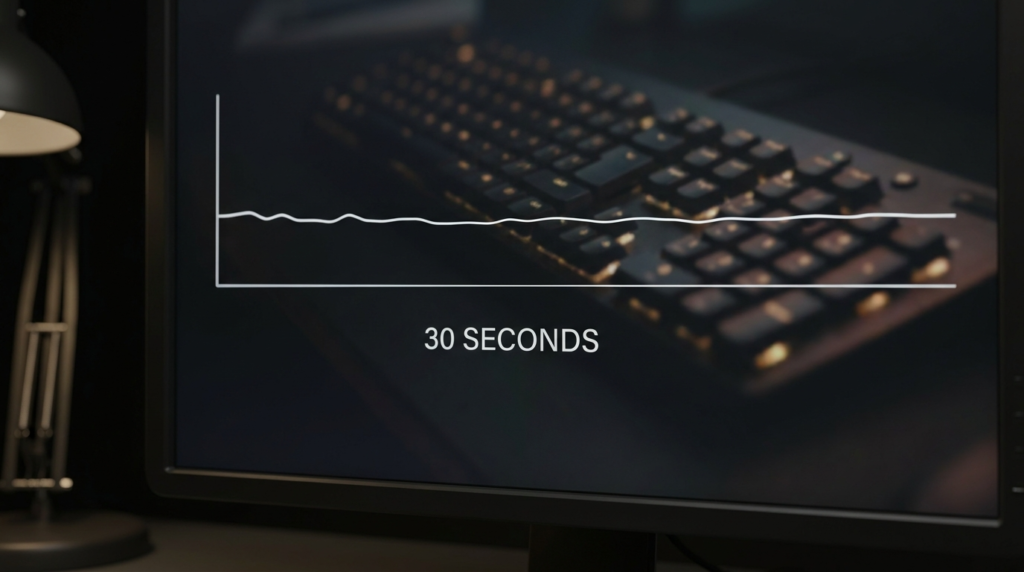
If your graph shows a sharp cliff in the first five seconds, your visual hook failed. The viewer clicked but immediately felt they were in the wrong place. If the graph slopes down steadily over 30 seconds, your script is too slow. You are taking too long to get to the point.
Adjust your approach based on this data. If a specific declaration open kept 75% of your audience, study the sentence structure you used. Replicate that exact rhythm in your next video.
Moving Beyond the First 30 Seconds
The cold open only gets them in the door. You have to deliver on the promise. Once the title card plays, you immediately transition into your exposition. Do not waste time with a secondary introduction.
Pick up the story exactly where the cold open left off. If you asked a question, begin answering it with historical context or data. The viewer gave you their trust by staying past the 30-second mark. Respect that trust by moving the story forward relentlessly.
Maintain the same sentence structure throughout the video. Use short, punchy statements. Keep the visual pacing tight. The rules of the cold open apply to the entire documentary. The open is simply the most concentrated version of your writing style.
Executing the Strategy in Your Next Upload
The difference between a channel that struggles and a channel that grows is discipline. Standard YouTubers rely on algorithms and trends. True news creators rely on structure. The broadcast cold open is a tool. You apply it to every single script, regardless of the topic.
Stop trying to trick people into watching your content. Build a hook based on undeniable facts, sharp syntax, and clear stakes. Write the open before you touch the rest of the script. Cut the adjectives. Track your retention data. Apply these constraints to your writing today, and watch your 30-second retention stabilize. The audience is there. They just need a reason to trust you.