
The reason you sound like a robot on camera is that you are writing for the eye instead of the ear. When we read a book, our eyes process complex grammar and long sentences easily. When we listen to a person, our brains need short bursts of information and familiar, conversational rhythms. Most creators fail because they paste a blog post into a teleprompter and wonder why they sound like they’re reciting a manual.
I’ve spent thousands of hours in front of teleprompters, from high-end studio rigs to iPad setups in my home office. I learned quickly that the script is the performance. If the script is clunky, the delivery will be stiff. You can’t “acting” your way out of bad writing. You have to change how you put words on the page before you ever hit record.
The Mental Shift from Print to Speech
Writing for a “One-Person Newsroom” means you are both the writer and the performer. You have to stop using “formal” English. We don’t talk in perfectly structured paragraphs with “furthermore” or “additionally.” We talk in fragments. We use slang. We trail off.
If you want to sound natural, you have to write the way you actually speak. This feels wrong at first because it looks “messy” on the screen. But when those words hit the air, they sound like a conversation between friends, not a lecture. I call this the Ear-First Method.
Print Style vs Broadcast Style
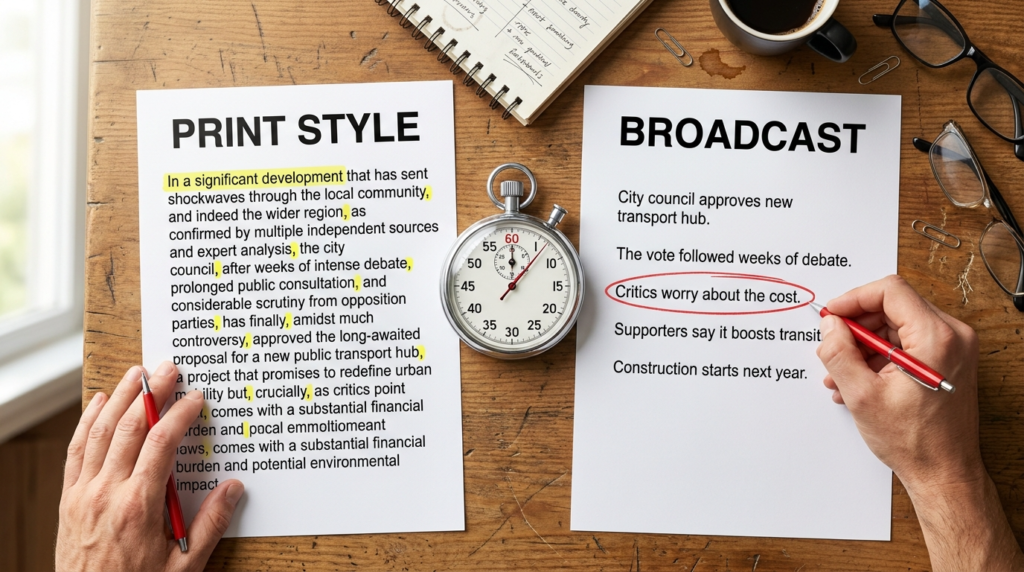
| Feature | Print Writing (The Eye) | Broadcast Writing (The Ear) |
| Sentence Length | 20–30 words | 5–12 words |
| Punctuation | Commas, semicolons, colons | Periods, dashes, ellipses |
| Contractions | Do not, It is, We are | Don’t, It’s, We’re |
| Attribution | “The mayor said” (at end) | “The mayor says” (at start) |
| Numbers | 1,250,400 | Over a million |
The Rule of One
I use the “Rule of One” for every sentence I write. This means one thought per sentence. If a sentence has a “which,” “who,” or “because” in the middle, it’s probably too long. I break it into two.
Long sentences force you to take weird breaths. When you run out of air, your voice goes up in pitch and you start rushing to the end. Your audience feels that tension. They stop listening to your message and start worrying about your lungs. By keeping sentences to one thought, you give yourself a natural place to pause and look at the camera.
Use the Contraction Rule Every Time
In school, teachers tell us never to use contractions in formal papers. In the newsroom, we do the exact opposite. If you don’t use contractions, you sound like an alien.
“It is a beautiful day” sounds like a weather bot. “It’s a beautiful day” sounds like a human. I scan my scripts for “do not,” “cannot,” “we will,” and “they are.” I change them to “don’t,” “can’t,” “we’ll,” and “they’re” immediately. This one change fixes about 40% of the “robotic” sound.
Punctuation is Your Secret Timing Map
Standard punctuation is for grammar. Broadcast punctuation is for breathing. I stopped using commas years ago because they aren’t strong enough cues for my brain when I’m under the lights.
Instead of commas, I use ellipses (…) or dashes (—). An ellipsis tells me to pause and let a thought land. A dash tells me to lean into the next word. When I see a period, it’s a hard stop. I actually drop my pitch at the end of every period to signal a finished thought.
- Period (.) = Full breath, pitch goes down.
- Ellipsis (…) = Short pause, keep the energy up.
- Dash (—) = Connect two ideas quickly without stopping.
The Attribution Flip
In a newspaper, you read: “The housing market is crashing, according to Zillow.” On camera, that’s a disaster. By the time you get to “Zillow,” the audience has already forgotten the first half of the sentence.
I always put the source first. “Zillow says the housing market is crashing.” This tells the audience who is talking before they hear the claim. It’s how we share gossip or news in real life. You wouldn’t say, “We’re out of milk, my wife said.” You’d say, “My wife said we’re out of milk.”
Phonetic Spelling for Hard Words
Nothing kills a take faster than tripping over a name. I don’t care how a word is actually spelled; I care how it sounds. If I’m talking about a city like “Albuquerque,” I write it as “AL-BU-KER-KEE” in the prompter.
This is especially helpful for technical terms or names of SaaS companies. If I’m mentioning a tool like “Airtable,” I might write it as “AIR-TABLE” to make sure I punch both syllables. It prevents that “deer in the headlights” look when a long word scrolls up.
Script Rewrite 1: The Tech News Update
Before (The Robot Version)
“Apple today announced that the new iPhone will be released on Friday. The device features a titanium frame which makes it significantly lighter than previous models. Additionally, the camera has been upgraded to forty-eight megapixels for better low-light photography.”
After (The Human Version)
“The new iPhone drops this Friday… and it’s a lot lighter. Apple switched to a titanium frame this time around. But the real story is the camera. It’s forty-eight megapixels… which means your night shots are finally going to look good.”
Why this works:
- I used “drops” instead of “announced that the new iPhone will be released.”
- I broke one long sentence into three short ones.
- I added a “bridge” phrase (“But the real story is…”) to lead the viewer.
- I used “It’s” instead of “It is.”
Script Rewrite 2: The Business Report
Before (The Robot Version)
“According to a report by HubSpot, sixty-five percent of marketers are concerned about the impact of artificial intelligence on their search engine rankings. Consequently, many are pivoting toward video-first content strategies to maintain their organic reach.”
After (The Human Version)
“Marketers are getting nervous about AI. A new report from HubSpot shows sixty-five percent of us worry it’ll tank our Google rankings. The fix? A lot of teams are pivoting to video. It’s the best way to keep people coming back.”
Why this works:
- Source first (“HubSpot shows…”).
- I changed “Consequently” to “The fix?” (Active question).
- I used “us” and “we” to build empathy with the audience.
- The sentence length varies from 5 words to 12 words.
Script Rewrite 3: The Productivity Tip
Before (The Robot Version)
“One should always remember to utilize the Pomodoro technique when attempting to focus on deep work tasks. This method involves working for twenty-five minutes and subsequently taking a five-minute break to ensure that mental fatigue does not occur.”
After (The Human Version)
“If you can’t focus… try the Pomodoro method. It’s simple. You work for twenty-five minutes… then you take five off. It keeps your brain fresh. Trust me… it beats burning out by noon.”
Why this works:
- I cut the preachy “One should always remember.”
- I used a “Hook-Statement-Proof” structure.
- I added a personal sign-off (“Trust me”) which feels like a friend giving advice.
- I used contractions (“can’t,” “it’s,” “it’s”).
Active Voice vs. Passive Voice
In a solo newsroom, you need momentum. Passive voice kills momentum. “The bill was signed by the President” is slow. “The President signed the bill” is fast.
I look for the “by” in my sentences. Usually, if I see the word “by,” I’ve written a passive sentence. I flip the subject and the action. This makes the script feel like it’s moving forward, which keeps the viewer from clicking away.
The Physicality of the Script
When I’m writing, I actually read the lines out loud as I type. If I trip over my tongue while sitting at my desk, I will definitely trip on camera. I call this the “Breathe-Out Test.”
If I can’t say a sentence comfortably in one breath while sitting down, I cut it. You have to remember that when you’re on camera, your heart rate is slightly higher. Your breathing is shallower. Your script needs to be “breathier” than you think it does.
Managing Your Teleprompter Settings
The writing is the foundation, but the tech matters too. I see people setting their prompter text too small. They end up squinting, which looks like they’re angry at the viewer.
I set my font size large—usually only about 3 to 4 words per line. This prevents “eye tracking.” If the lines are too wide, your eyes move left-to-right like you’re reading a book. If the lines are narrow, your eyes stay centered on the lens. This makes it look like you’re just talking from your head.
Teleprompter Setup Checklist
| Item | Ideal Setting | Reason |
| Font Size | Extra Large (72pt+) | Prevents squinting and eye-strain. |
| Width | Narrow (30-40% of screen) | Stops eyes from moving left-to-right. |
| Speed | 10% faster than you think | Forces you to keep your energy up. |
| Text Color | White on Black | High contrast is easier to read under bright lights. |
| Line Spacing | Double (2.0) | Helps you find your place if you look away. |
The “So What?” Test
Every time I finish a news segment script, I ask: “So what?” If my script sounds like a Wikipedia entry, I failed. I add a “Why this matters” section to the end of every news item.
In a one-person newsroom, people aren’t just coming for the facts. They can get facts from a Google search. They come to you for the “why.” I write the news, then I write my reaction to the news. That’s where the “natural” voice really lives.
How to Practice Without a Camera
I tell people to record their scripts into a voice memo app first. Don’t look at the paper. Just try to explain the story to the app as if you’re telling a friend at a bar.
Then, listen back. You’ll notice you used different words than what’s in your script. You’ll notice you skipped the boring parts. Transcribe your own voice memo. That transcript is your real script. It will be 100% natural because it came from your mouth, not your keyboard.
Eliminating “Wait” Words
I watch out for “Wait” words—words that make the listener wait for the point. These are words like “basically,” “actually,” “honestly,” and “really.” They add no value.
- “Basically, the stock market is down.” (Weak)
- “The stock market is down.” (Strong)
I cut these during the editing phase. In a solo newsroom, you only have a few seconds to grab attention before someone scrolls. Every word must earn its place on that glass.
The Power of the “You”
I count how many times I use the word “you” versus “I.” If I’m talking about myself too much, I sound like an egoist. If I’m talking about “the people” or “users,” I sound like a corporate PR firm.
I use “you” to talk directly to the person behind the screen. “You need to know this” or “Here is how you can fix this.” It turns a broadcast into a 1-on-1 meeting. This is the biggest secret to sounding like a professional news anchor in 2026—stop acting like an anchor and start acting like a guide.
Handling Mistakes in the Copy
Even with the best copy, you will stumble. I used to stop the recording and start over. Now, I write “recovery lines” into my scripts. If a sentence is particularly hard, I’ll write a joke right after it.
If I mess up, I stay in character, laugh it off, and say “Let me try that again.” I keep that in the final edit sometimes. It shows the audience I’m a real person. Authenticity is worth more than a “perfect” read.
Final Scripting Checklist for Natural Delivery
- Did I use contractions everywhere?
- Is there only one thought per sentence?
- Did I put the source/attribution at the beginning?
- Are hard names spelled phonetically (AL-BU-KER-KEE)?
- Did I replace commas with ellipses or dashes?
- Is the font large enough that I don’t have to squint?
- Does the script pass the “Breathe-Out Test”?
If you follow these steps, you’ll stop reading and start talking. The teleprompter becomes a safety net, not a cage. You’ll find that your “on-camera persona” eventually just becomes you—only a little more organized and a lot easier to understand.