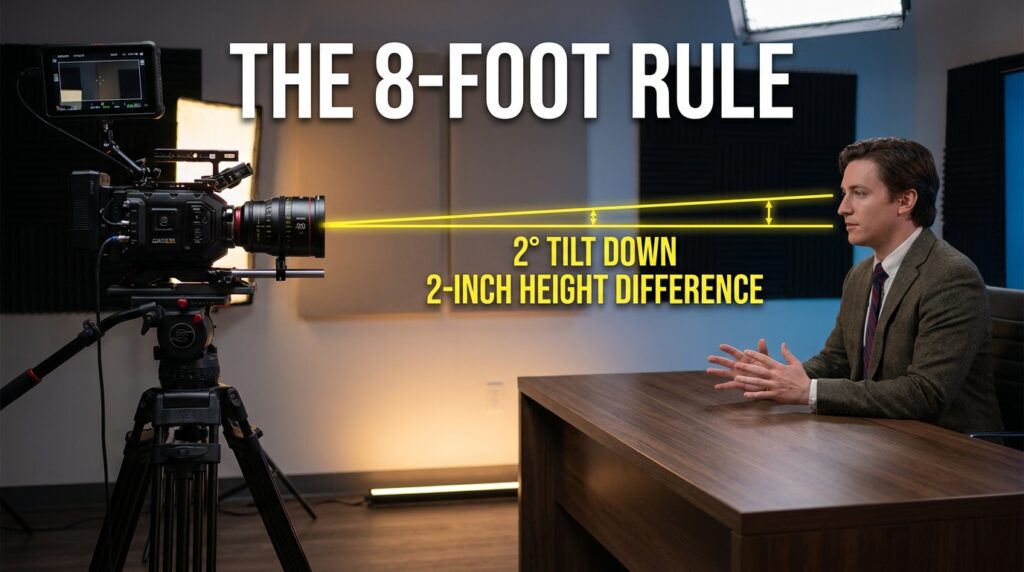

Stop putting your camera dead straight at eye level. If you want the CNN, Fox News, or BBC broadcast aesthetic, a perfectly flat angle destroys your authority. Network television anchors sit exactly 8 to 10 feet from the camera lens. The camera is placed two to three inches above their natural eye line. The tripod then tilts down by exactly 2 to 3 degrees.
This creates a psychological perception of authority while maintaining approachability. We build these setups for one-person newsrooms, and the math never changes. When you match the specific focal length, downward tilt, and distance-to-subject ratio, you replicate a million-dollar studio look from a spare bedroom.
The Broadcast Engineering Specification for Height
Most YouTube creators read basic tutorials and set their lens precisely parallel to their pupils. This creates a confrontational, staring-contest aesthetic. In a professional broadcast environment, we position the optical center of the lens slightly higher.
The 2 to 3 Inch Elevation Rule
Measure the distance from the floor to your eyes while seated at your desk. Let’s say that measurement is 48 inches. You need to set the center of your camera lens at 50 or 51 inches. This slight elevation forces you to tilt your chin up barely a fraction of an inch. It tightens the jawline and eliminates neck shadows. You look engaged and forward-leaning.
The Micro Downward Tilt
Once the camera sits above your eye line, tilt the lens down by exactly 2 degrees. A zero-degree tilt cuts off the top of your head or shows too much ceiling. A 5-degree tilt makes you look small and submissive. Two degrees of downward framing places your eyes exactly on the upper third grid line of the screen. This is the exact geometric framing you see every night on evening broadcasts.
Focal Length and Facial Compression Reality
A 24mm lens placed 3 feet away distorts the human face. It bulges the nose and pushes the ears back. This is the classic webcam look that instantly flags your setup as amateur. News networks use optical compression to flatten facial features into a pleasing, authoritative portrait.
The Problem with Wide Lenses
Wide lenses stretch objects at the edges of the frame and magnify whatever is closest to the glass. If you lean forward into a 24mm lens, your forehead balloons in size. We replace wide-angle lenses with short telephotos when building presenter desks. You want your face to look mathematically proportionate, regardless of how you lean or shift in your chair.
Why 85mm at 8 Feet is the News Anchor Standard
An 85mm lens placed 8 feet away from the anchor forces perspective compression. The background appears closer to you, and your facial proportions normalize. This exact combination isolates the subject and removes the harsh spherical distortion common on consumer cameras.
- 24mm at 3 feet: Distorts the nose, widens the face, and captures too much distracting side wall.
- 35mm at 5 feet: Acceptable for documentary interviews, but still lacks the tight framing needed for news delivery.
- 50mm at 6 feet: The bare minimum for a credible newsroom desk setup.
- 85mm at 8 feet: The broadcast standard. It isolates the subject and provides perfect facial geometry.
| Lens Focal Length | Distance to Subject | Visual Effect on Face | Primary Use Case |
| 24mm | 3 Feet | Heavy Distortion | Vlogging, Action Cams |
| 35mm | 5 Feet | Mild Distortion | Environmental Docs |
| 50mm | 6 Feet | Natural | Standard Interviews |
| 85mm | 8 Feet | Compressed/Flat | Studio News Anchor |
The Distance-to-Subject Ratio for News Desks
Your desk depth dictates your authority on screen. If you sit flush against a wall, you look trapped. If the camera is too close, you look aggressive. You need physical space between your chest and the glass of the lens.
The 8-Foot Minimum Working Distance
Eight feet is the golden measurement. This distance allows the anchor to use hand gestures without those hands becoming comically large in the foreground. It also provides room for proper lighting stands to sit out of frame.
Fixing Teleprompter Eye Tracking
If you use a teleprompter, an 8-foot distance solves the worst amateur mistake: visible eye reading. When you read a script from 3 feet away, the viewer sees your eyes darting left and right. At 8 feet away, the angular movement of your pupils becomes completely imperceptible. The lens cannot resolve the micro-movements of your eyes, making it look like you are speaking entirely from memory.
Framing the Anchor Shot
Networks do not guess where the anchor sits in the frame. They follow strict composition rules that differ heavily from standard cinematic framing. Cinematic framing often uses negative space to convey emotion. News framing fills the space to convey information.
The Two-Button Crop
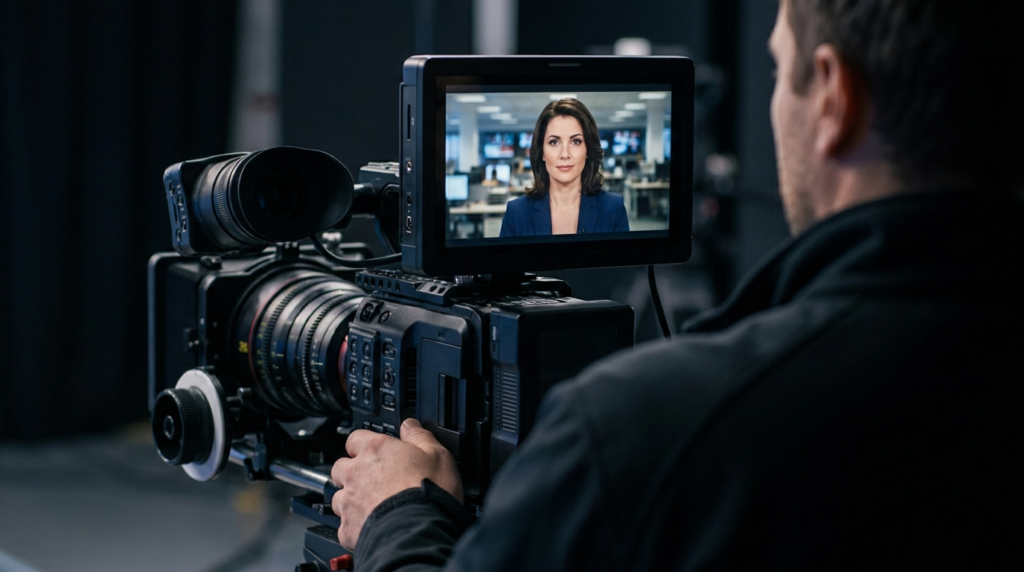
Look at any anchor on Bloomberg or CNBC. The bottom edge of the frame cuts off right below the second button of their jacket. This is the standard news medium close-up. It shows enough of the torso to establish body language but keeps the face dominant. A wider shot loses the viewer’s focus. A tighter shot feels claustrophobic and suffocating.
Managing Headroom Margins
Headroom is the space between the top of your hair and the top edge of the video frame. Amateurs leave a massive gap above their heads. Professionals leave exactly two to three fingers of space. Any more, and you look like you are sinking into the desk. Any less, and the shot feels like the ceiling is crushing you.
Replicating Studio Depth of Field
A blurry background does not equal a professional background. YouTubers love shooting at an aperture of f/1.4 to obliterate their room into mush. News networks keep the background recognizable but slightly soft. The viewer needs to see the monitors, the newsroom, or the set design to buy into the authority of the space.
The f/4 to f/5.6 Aperture Sweet Spot
When we set up cameras for financial analysts or political commentators, we lock the aperture between f/4 and f/5.6. This keeps your entire head in sharp focus. If you lean forward, your nose does not go out of focus. The background softens enough to separate you from the wall, but viewers can still see the studio environment clearly.
- Shooting wide open (f/1.4): Only one eye stays in focus. The background vanishes entirely.
- Shooting closed down (f/8): Everything is in focus. Distractions behind you pull attention away from the news delivery.
- Managing background distance: You need at least 4 feet between your chair and the wall behind you for the background to drop slightly out of focus at f/4.
Setting Up the Teleprompter Geometry
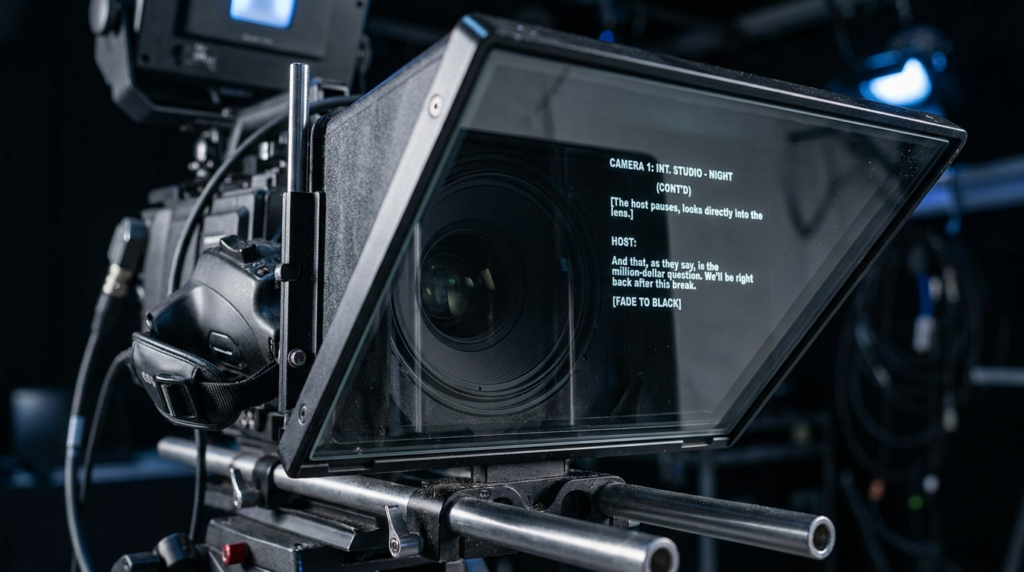
The teleprompter changes the physics of your camera setup. You are no longer looking at a bare lens; you are looking at text reflected on beam-splitter glass.
Aligning the Text with the Lens Center
Do not set the text margin to span the entire width of your prompter screen. Shrink the margins so the text columns sit directly over the center of the camera lens. If your text runs to the edges of a 15-inch iPad, your eyes will physically sweep back and forth even at 8 feet away. You want a narrow, centralized column of text.
The Prompter Brightness Equation
Turn the brightness of your prompter tablet down to the lowest readable level. If the screen is too bright, it reflects onto your glasses or creates an artificial blue glow on your cheeks. The light hitting your face must come from your key light, never from your teleprompter screen.
Lighting Angles to Match the Camera Position
Camera position means nothing if the lighting angle fights the lens geometry. News lighting is flat, even, and highly consistent. It does not use heavy shadows or dramatic side lighting.
The Broad Key Light Placement
Place your main light directly above the camera lens, slightly angled down. Do not place it 45 degrees to the side. Side lighting creates shadows on half the face. That works for dramatic movies but fails for news delivery. News anchors need broad, soft light that fills every wrinkle and shadow.
The Catchlight Requirement
A catchlight is the white reflection of the light source in your pupils. This reflection makes your eyes look alive and attentive. By placing the key light directly behind and slightly above the camera lens, the catchlight sits in the top center of your eyes. A face without catchlights looks dead and untrustworthy on camera.
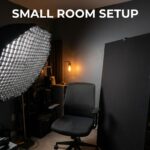
Building the Setup in a Small Room
Not everyone has a massive commercial studio. You can replicate this exact geometry in a spare bedroom by altering how you position the desk against the architecture of the room.
The Diagonal Room Strategy
If you have a 10×10 foot room, sitting flat against one wall gives you 10 feet of maximum working distance. By placing your desk in a corner and shooting diagonally toward the opposite corner, you gain over 14 feet of working distance. This allows you to fit the 85mm lens, the 8-foot camera distance, and the required 4 feet of background separation into a standard residential room.
| Room Setup Type | Wall-to-Wall Distance | Usable Depth for Camera | Background Separation Possible |
| Flat Against Wall | 10 Feet | 8 Feet | 0 to 1 Foot |
| Diagonal Corner | 14.1 Feet | 8 Feet | 4 to 5 Feet |
| Center Room | 12 Feet | 7 Feet | 3 Feet |
Sound Treatment for the 8-Foot Setup
When the camera sits 8 feet away, you cannot use a camera-mounted shotgun microphone. The mic is simply too far from your mouth. The audio will sound like you are broadcasting from an empty hallway. The inverse square law of audio dictates that your microphone must be within 18 inches of your mouth.
Boom Microphone Placement
Suspend a shotgun microphone on a boom arm directly above your head, just barely out of the top of the video frame. Aim the capsule directly at your sternum, not your mouth. This captures the deep chest resonance that news anchors rely on for vocal authority. It rejects the echo from the computer monitors on the desk below.
The Final Pre-Flight Checklist
Before hitting record on any news delivery, we run through a mechanical checklist. This guarantees the spatial geometry remains intact day after day. Small shifts in the tripod ruin the perspective.
- Check the 2-inch elevation: Verify the center of the lens sits exactly two inches above the natural eye line.
- Confirm the 2-degree tilt: Ensure the camera aims slightly downward at the face. Use a digital level on your smartphone.
- Measure the 8-foot gap: Tape the floor marks so the chair and tripod never drift closer together.
- Set the f/4 aperture: Lock the exposure so the depth of field remains consistent across every video.
- Verify the two-button crop: Frame the bottom edge just below the upper chest to maintain the medium close-up standard.